The Harness Advantage
Why the deterministic scaffolding around a model, not the model itself, is the real differentiator.
Ibrahim AbuAlhaol, PhD, P.Eng., SMIEEE
AI Technical Lead
The most expensive mistake in enterprise AI right now is treating the model as the product. Foundation models, whether massive proprietary endpoints or open-weight checkpoints you run yourself, hold staggering amounts of compressed knowledge and can ace nearly any standardized benchmark you put in front of them. That is the truth. The honesty is harder to say out loud: these models are probabilistic engines. Ask one the same question twice and you may get two different answers. Ask it a question it cannot answer and it will often answer anyway, fluently and wrong.
A benchmark leaderboard measures the engine on a dynamometer: controlled inputs, a fixed course, a single number at the end. Production is a public road. There are pedestrians, weather, and other drivers. Nobody would license a car for the road because its engine posted a good dyno number, yet that is exactly how most organizations pick and deploy AI: compare benchmark scores, wire the winner to a chat window, and hope.
The engine is not the vehicle
A language model does one thing: it predicts the next most likely token, one token at a time. "Most likely" is not the same as "correct," and it is not the same as "safe." Holtzman and colleagues documented this years ago in their work on text degeneration: the raw probability distribution a model produces can drift into repetition or incoherence, and every practical system already reshapes that distribution with sampling tricks before a user ever sees output [2]. In other words, even the vendors do not ship the raw engine. The question is only how much reshaping happens, and who controls it.
For a consumer chat app, occasional drift is a shrug. For an enterprise it is a wrong SQL statement executed against a finance database, a fabricated clause quoted from a policy document, or an agent that emails a customer something it should never have said. The failure is not that the model is weak. The failure is that a probabilistic component was placed in a position of authority that should belong to deterministic code.
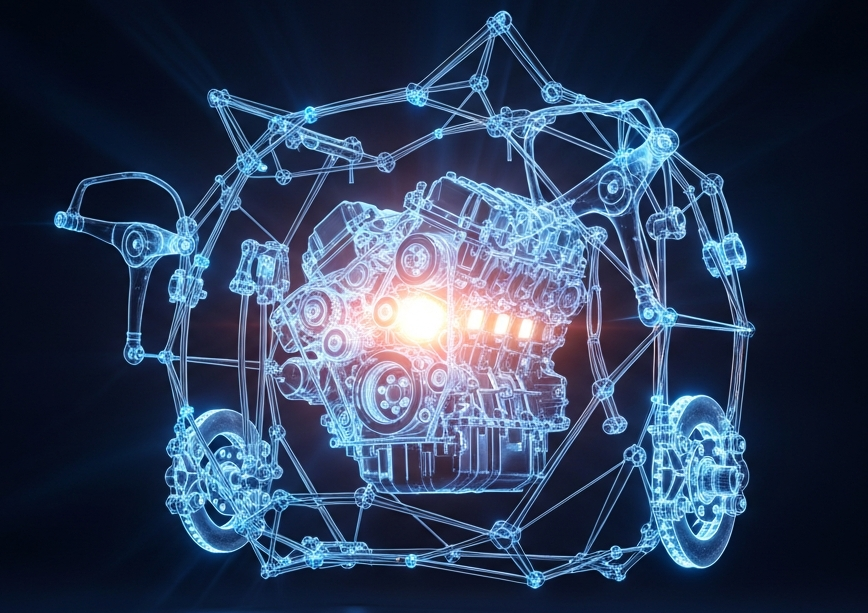
The model is just the engine. The harness is the steering, the brakes, and the transmission. Nobody ships an engine to a customer; they ship a vehicle, and the vehicle is what they are judged on.
By harness I mean everything deterministic that surrounds the model: the code that decides what the model sees, what it is allowed to produce, what happens to its output before anything acts on it, and where the whole thing physically runs. The harness is ordinary software. It is testable, versioned, and auditable. And it, not the model, is where accuracy and efficiency are actually won.
The harness drives accuracy
A raw model wants to produce plausible text. A harness forces it to produce text that passes checks. The difference sounds subtle and is everything.
The first tool is constrained generation. Willard and Louf showed that you can restrict a model's output to a formal grammar, such as a JSON schema or a SQL dialect, by masking invalid tokens at each step, and that this can run with almost no overhead [3]. The model still chooses the words, but it becomes mathematically incapable of producing malformed output. The model proposes; the grammar disposes.
The second tool is the verification loop. Anthropic's guidance on building agents makes the point plainly: the systems that work in production are built from simple, composable patterns with explicit checkpoints, not from a model given an open loop and full autonomy [1]. Generate, validate against a schema or a test, feed failures back, retry with the error in context. Each pass through deterministic validation converts "probably right" into "verified or rejected."
The third tool is the permission gate. Toolkits like NeMo Guardrails exist precisely because dialogue and tool use need programmable rails: which topics are in bounds, which tools the model may call, which actions require a human signature [4]. The model never holds the keys. It requests; deterministic code decides. When an agent misbehaves inside a harness, you read the audit log and tighten a rule. When a raw model misbehaves at a customer boundary, you write an apology.
The harness drives efficiency
Calling a cloud API is the easy path, and for many workloads the right one. But every call ships your context to someone else's computer, waits in someone else's queue, and lands on a bill priced per token in someone else's currency of usage tiers. Latency, data exposure, and cost all sit outside your control.
Owning the serving environment moves those levers inside. The vLLM project demonstrated that memory management alone, through paged attention over the key-value cache, can multiply serving throughput two to four times on identical hardware and an identical model [5]. That gain has nothing to do with model quality. It is pure harness engineering, and it accrues to whoever controls the serving stack.
Routing is the same story. Most enterprise requests are routine: classify this ticket, extract these fields, draft this summary. A harness that routes routine work to a small local model and escalates only hard cases to a frontier endpoint can cut cost dramatically while validators hold the quality line, because every output still has to pass the same deterministic checks regardless of which engine produced it. Add caching for repeated prompts and batching for bulk jobs, and cost stops being a bill you discover at month end and becomes a budget you set in advance.
What a harness actually contains
Concretely, a production harness is a short list of unglamorous components:
- Schema-constrained decoding or strict output validation for anything a machine will consume downstream.
- Deterministic validators: schema checks, unit tests, policy rules, reference lookups against ground truth.
- A retry loop that feeds validator failures back to the model with the error message in context.
- Permission gates on every tool and action, with human sign-off required above a defined risk line.
- A routing layer that picks the cheapest model that passes validation, plus caching for repeated work.
- An audit log of every prompt, output, validation result, and action taken.
The core control flow fits in a few lines:
for attempt in range(MAX_RETRIES):
    output = model.generate(prompt, schema=TASK_SCHEMA)
    result = validate(output)          # deterministic, versioned, tested
    if result.ok:
        return gate.execute(output)    # permission check before any action
    prompt = prompt + result.error     # feed the failure back
raise EscalateToHuman(output, result)
Every line of that loop is ordinary software your team already knows how to test and operate. That is the point. The probabilistic engine sits inside a deterministic contract, and the contract is yours.
Where the differentiation actually lives
Frontier models are converging. Scores cluster, capabilities overlap, and whatever gap exists today narrows with the next release from a competitor. If your advantage is "we call the best model," you have an advantage that expires quarterly and is available to anyone with a credit card.
The harness does not expire. It encodes your data boundaries, your risk policies, your validation standards, and your cost discipline, and it compounds: every incident becomes a new rule, every failure mode becomes a new test. When a better engine ships, a well-built harness lets you swap it in behind the same contracts in days. The engine is rented. The vehicle is owned. Build the vehicle.
What leaders should do
- Map every point where raw model output reaches a user, a database, or an external system without passing through deterministic validation, and close those gaps before adding any new AI features.
- Mandate schema-validated structured outputs for all machine-consumed generations, and adopt constrained decoding wherever you control the serving stack.
- Stand up a routing and caching layer, then change the metric your teams report from cost per token to cost per validated task.
- Fund the harness as a product: give it an owner, a test suite, an audit log, and a roadmap, and require that any model swap pass through its contracts unchanged.
Related Articles
References & Extended Literature
- Anthropic. "Building Effective Agents." Anthropic Engineering, 2024. https://www.anthropic.com/engineering/building-effective-agents
- Holtzman, A., Buys, J., Du, L., Forbes, M., & Choi, Y. "The Curious Case of Neural Text Degeneration." ICLR 2020. https://arxiv.org/abs/1904.09751
- Willard, B. T., & Louf, R. "Efficient Guided Generation for Large Language Models." arXiv, 2023. https://arxiv.org/abs/2307.09702
- Rebedea, T., Dinu, R., Sreedhar, M., Parisien, C., & Cohen, J. "NeMo Guardrails: A Toolkit for Controllable and Safe LLM Applications with Programmable Rails." EMNLP 2023. https://arxiv.org/abs/2310.10501
- Kwon, W., et al. "Efficient Memory Management for Large Language Model Serving with PagedAttention." SOSP 2023. https://arxiv.org/abs/2309.06180