 Ibrahim AbuAlhaol
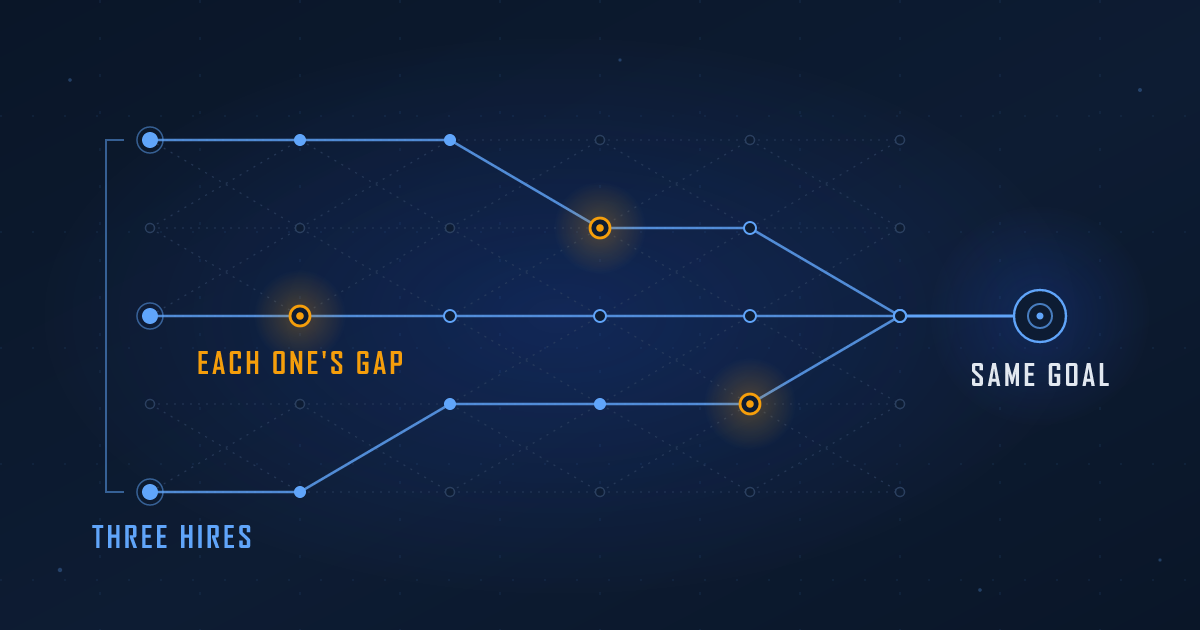
Three new hires join the same AI team in the same month: a backend engineer, a statistician from academia and a new data science graduate. All three get the onboarding guide the team's most senior engineer wrote years ago. By the end of week two all three are stuck, two of them on the same page for different reasons.
Nothing in the guide is wrong. It follows one route through the material, its author's, and it starts from what the author assumes everyone already knows. Every step the author no longer notices taking is missing. The fix is to write down what depends on what. AI now makes that map cheap to draft, and new hires' answers make it cheap to check.
Experts cannot see the steps they skip
The senior engineer is not careless. Expertise hides its own steps. When three expert surgeons were recorded teaching an emergency airway procedure, they left out 71% of the clinical knowledge steps, 10 of 14, compared with a task list later built from structured expert interviews.1
Experts also misjudge beginners. In two studies, people with more expertise were worse at predicting how long novices would take on a task, and they resisted the techniques meant to correct the error.2 Education research calls this the expert blind spot.3
Most teams onboard by seniority instead. In a survey of 37 Microsoft managers, 86% started junior hires on simple tasks and moved them to complex ones, against 49% for senior hires.4 Seniority is a blunt label. The statistician is senior in statistics and junior in production pipelines, and no single starting page fits both halves.
Every guide rests on a hidden map
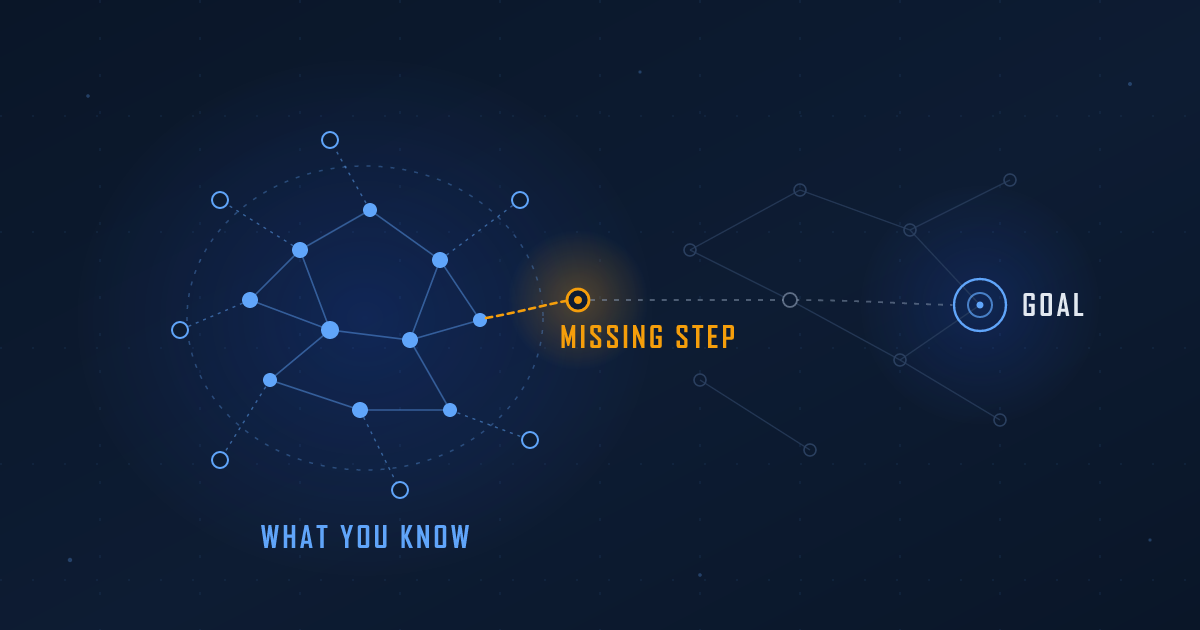
Under every onboarding guide sits a structure nobody has written down: which topics need which other topics first. You cannot spot data leakage in a pipeline without understanding how training and test data are kept apart. Draw each "needs" as an arrow and you have a prerequisite map. Knowledge Space Theory, a mathematical account of learning, is built on exactly this kind of map.5
A guide is one path through that map, its author's. This guide never teaches six topics its author handles without thinking, among them base rates and data leakage. Each hire stalls at the first page that relies on a step they lack, while a hire who already knows more wades through pages they could skip.
The page tells you where each hire stopped, not why. The statistician has never had to think about data leakage, the graduate has never weighed base rates, and page 5 assumes both. The map names the gap.
A degree is the same map at the scale of courses, and I have drawn one: at Princess Sumaya University for Technology I led the faculty committee that designed the bachelor's and master's curricula for a new Data Science department. A study plan has the same blind spot. It puts statistics before machine learning without naming which statistics topics machine learning needs.
AI can draft the map
Drawing the map used to be the expensive part. Since 1990 the theory has had a method for drawing it out of an expert, a long series of questions of one shape.6 In a team's words: if a new hire fails a question on standard errors, are they practically certain to fail one on confidence intervals too?7
A language model can answer all of those questions in minutes, but it is not reliable on its own. In a 2026 study, the best models matched experts on about 70% of 307 pairs of mathematics standards, yet they also linked a quarter to over a third of the pairs that had no link.8 A real map has far more unrelated pairs than linked ones, so those false links add up fast.
So treat the result as a draft. Your senior engineer accepts or rejects every link, starting with the ones the model answered inconsistently. Keep the map in the repository as a two-column table with a one-line reason per link, changed only by pull request. Drafting knowledge graphs with language models and having experts verify them is my own research field, and the rule there is the same: the expert checks the shakiest links first.
For the technical reader: the method and the numbers
Koppen and Doignon's 1990 procedure builds the map from an expert's answers to a chosen sequence of questions.6 Forty topics make 1,560 ordered pairs, though only a fraction need asking, because the procedure infers many answers from a few. Later rounds ask about groups of topics, to catch a topic with more than one route in, and there even experts answer less reliably.7 That inference is also the risk with a language model: it does not always give the same answer twice, and one wrong answer spreads. Ask each question twice, in both directions, and send every disagreement to the expert.
On the 2026 study: half the pairs had no link, so always answering "no link" would score about 50%, and agreement corrected for chance was only moderate; the authors say people still need to check the output.8 In the theory's terms, a learner's ready-to-learn topics form the outer fringe, and placement starts there. ALEKS caps its first assessment at 30 questions, labels whatever it cannot settle as uncertain, and adds one random question, left out of the result, to test the system itself.9
Start new hires where they are
Once the map exists, onboarding can start with placement: a short check of what a new hire already knows, so they begin at the next steps they are ready for instead of at page one. Experienced hires gain the most. The statistician skips the graduate-school pages and spends the week on data leakage. The Missing Step shows how a few questions along the map find where a stuck hire's gap is.
Universities already work this way. From 2007, the University of Illinois placed students into precalculus and calculus with an ALEKS assessment, more than 15,000 assessments for about 10,000 students, and every placement course then had fewer D, F and withdrawal grades combined than in 2006.10 It was a before-and-after comparison, not a trial, but the logic transfers. Every syllabus is an onboarding guide written by its own senior engineer.
New hires' answers test every link
An AI-drafted map will be confidently wrong in places, and a wrong map can be worse than none. A map that encodes a false prerequisite sends people the long way around, every time, with the authority of a diagram.
Experts get links wrong too. In a study of 48 future teachers, those with more advanced mathematics were more likely to treat equations as a prerequisite for word problems, at odds with how students perform.3 In a chemistry course, a map built from students' answers held links the experts never drew.11
The good news is that every link makes a prediction you can check: almost nobody should be able to do the later topic without the earlier one. If new hires keep passing the later topic while failing the earlier one, the link is wrong.
Two habits keep the check honest. Now and then ask a question the map says you could skip, or you will never see the counterexamples. And because anyone can slip or guess, re-ask a surprising answer before you drop a link.
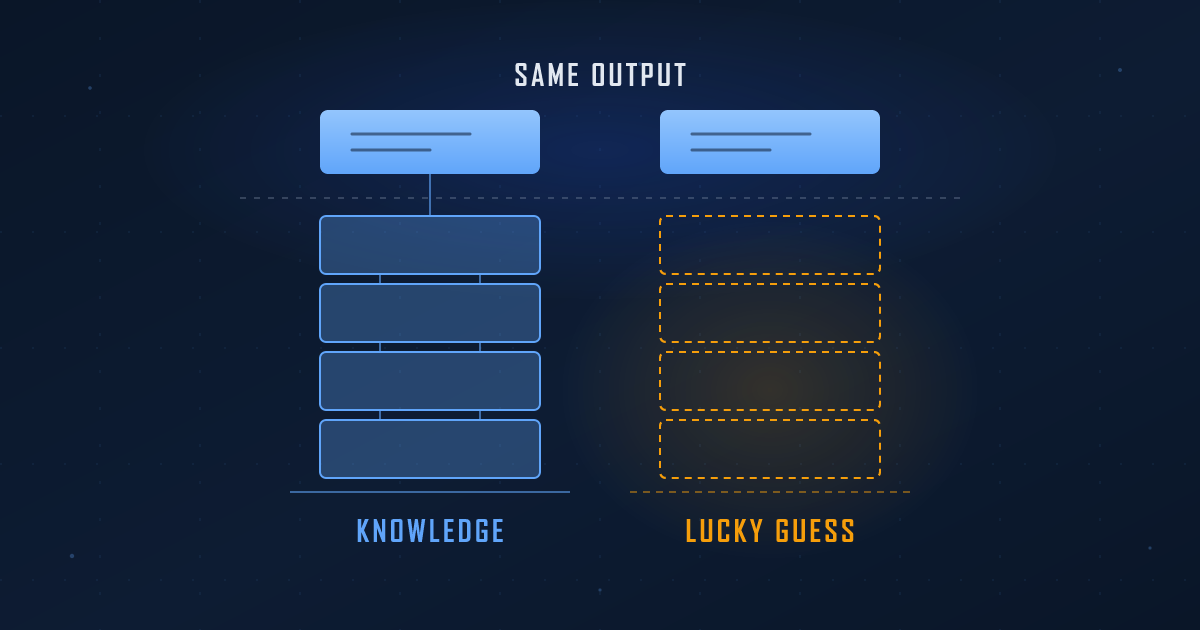
In our guide, the first page, on setting up a long-retired compute cluster, fails that test: hires who skip it pass every later page. The page goes. I know of no published study that applies this to onboarding an AI team, so treat it as a design to pilot. A map also trusts that a right answer means the learner knows, a trust AI has made harder to keep, as The Lucky Guess Problem explains.
What leaders should do
- Ask an AI assistant to draft a map of your team's 20 to 40 core topics with a one-line reason per link, and have your most senior engineer accept or reject every link. The team lead owns it.
- Place your next new hire with a short check against the map, start them at the steps they are ready for, and track days to their first approved model review.
- Run the check once on your current team, senior engineer included, and fix or drop any link that people keep passing without its prerequisite.
- For two courses students often fail in sequence, draft a topic-level map with an AI assistant and have both instructors rule on every link. The program chair owns it; it is done when both syllabi change.