 Ibrahim AbuAlhaol

The most reliable predictor of a long, healthy life is not your salary, your title, or your cholesterol. It is the quality of your relationships. That is the headline finding of the longest study of adult life ever run, and most of us organize our weeks as if we had never heard it.1
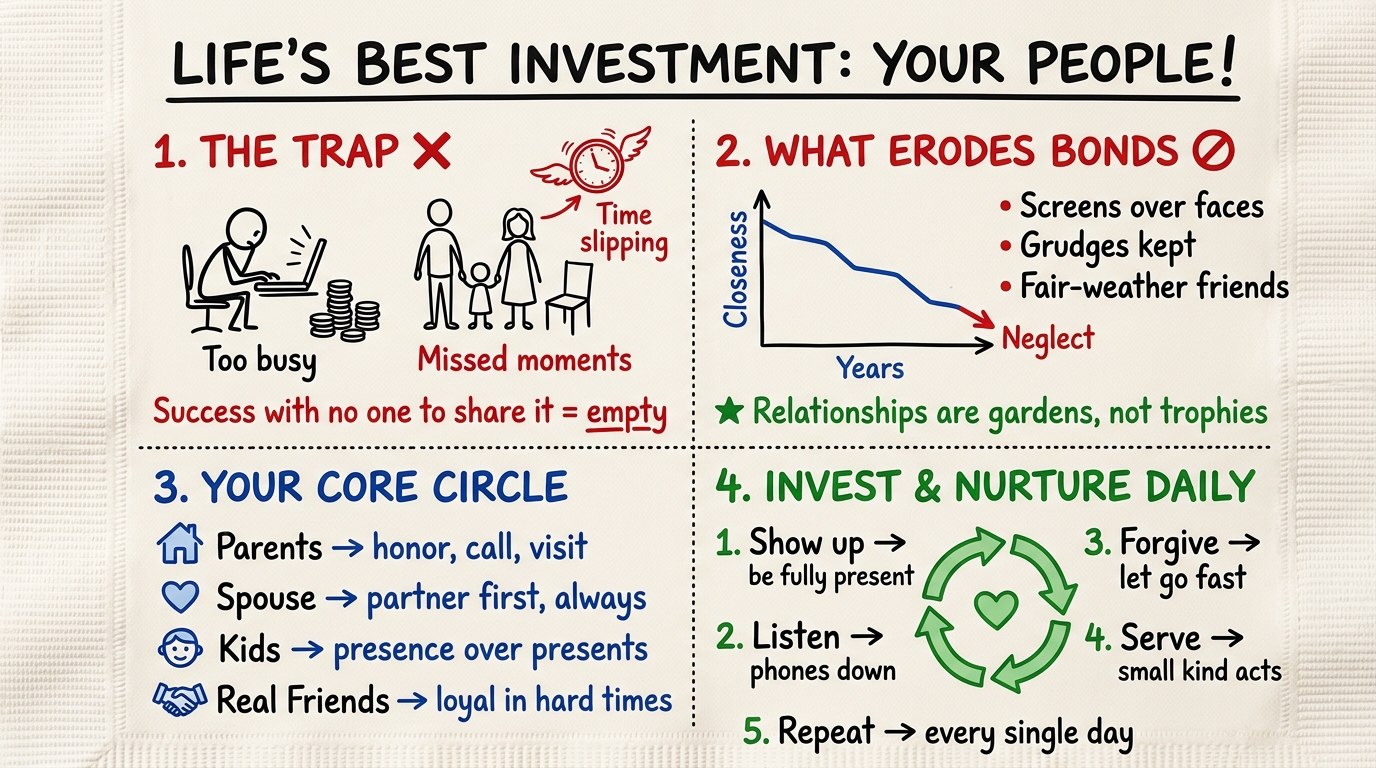
I found the clearest summary of this idea on a napkin. It is a hand-drawn sketch titled "Life's best investment: your people!" with four panels: the trap, what erodes bonds, your core circle, and a daily practice. Each panel is simple enough to fit on a napkin, and each one is backed by more research than it looks. This article walks through the sketch one panel at a time.
Relationships predict health in old age
The Harvard Study of Adult Development began in 1938 with 724 young men, some of them Harvard sophomores and some of them boys from Boston's poorest neighbourhoods. Researchers have followed them, and later their children, for more than 85 years.1 Robert Waldinger, the study's current director, puts the result plainly: the people who were most satisfied in their relationships at age 50 were the healthiest at age 80. Relationship satisfaction in midlife predicted physical health in old age better than cholesterol did.2
The Harvard result is not an outlier. A 2010 meta-analysis by Julianne Holt-Lunstad and colleagues pooled 148 studies covering more than 300,000 people and found that people with stronger social relationships had a 50% higher likelihood of survival over the study periods.3 In 2023 the U.S. Surgeon General issued an advisory on loneliness that compared the mortality effect of social disconnection to smoking up to 15 cigarettes a day.4
Relationships behave like an investment account that charges a fee every month. Leave it alone and the balance falls. Small, regular deposits are the only thing that keeps it growing.
Work bills today, relationships bill later
The first panel shows a figure hunched over a laptop next to a stack of coins, labelled "too busy." Beside it stands a family holding hands next to an empty chair, labelled "missed moments," with a winged clock flying away under the words "time slipping." The caption underneath is the sharpest line on the napkin: success with no one to share it is empty.
The trap works because the costs arrive on different schedules. Work sends its bills today, with deadlines, emails, and a manager who notices. Relationships send theirs years later, quietly, as an empty chair at dinner or a friend who stopped calling. Bronnie Ware, a palliative care nurse, recorded the most common regrets of her dying patients. "I wish I hadn't worked so hard" came from every male patient she nursed. "I wish I had stayed in touch with my friends" was close behind.5
Nobody in her account wished for one more quarterly target. The coins in the sketch are not the enemy. The problem starts when they become the only thing you count.
Decline is the default
The second panel is a small chart. Closeness sits on the vertical axis and years on the horizontal one, and the line slides steadily down until a red arrow points at the word "neglect." Next to it are three named forces: screens over faces, grudges kept, and fair-weather friends.
The chart makes the most important point in the whole sketch. Decline is the default. Nobody has to do anything wrong for a relationship to fade; they only have to do nothing. Figure 2 redraws the napkin's line next to its opposite.
Each of the three forces has evidence behind it. Screens are the easiest to see. In a 2013 study, Andrew Przybylski and Netta Weinstein found that the mere presence of a mobile phone on the table, not even in use, lowered how close and connected strangers felt after a meaningful conversation.6 Grudges are slower. Each one is a withdrawal you keep making long after the original event. Fair-weather friends are the hardest to spot because they look like real friends until the weather changes.
The green line under the panel sums it up: relationships are gardens, not trophies. A trophy, once won, sits on a shelf and stays won. A garden you stop tending becomes weeds.
The core circle decides where hours go
The third panel narrows the focus to four groups, each paired with a short instruction:
- Parents: honor, call, visit. The window is finite, and it is shorter than it feels.
- Spouse: partner first, always. Of all the bonds on the list, this one is the easiest to put on autopilot.
- Kids: presence over presents. Children remember who showed up, not what was in the box.
- Real friends: loyal in hard times. This is the test that separates them from the fair-weather kind in panel two.
The list is short on purpose. Friendship takes time to build, and time is the scarce input. Jeffrey Hall at the University of Kansas estimated that moving from acquaintance to casual friend takes roughly 50 hours together, to friend about 90 hours, and to close friend more than 200.7 Nobody has 200 hours for everyone. A core circle is a decision about where those hours go.
Small daily bids decide the line
The last panel is a loop of green arrows around a heart, with five steps: show up and be fully present; listen with your phone down; forgive and let go fast; serve through small kind acts; and repeat every single day.
The loop shape is the point. None of these steps is dramatic. Relationships are built in small moments far more than in grand gestures. John Gottman's research on couples calls these moments "bids": a comment, a question, a hand on the shoulder. Each one is a small request for attention. In his study of newlyweds, couples who were still married six years later had turned toward each other's bids about 86% of the time. Couples who later divorced had done so about 33% of the time.8
That gap is made of tiny choices: looking up from the screen, answering the question, laughing at the joke. Each one is cheap. Repeated daily for years, they decide which line in Figure 2 you end up on.
Run the napkin as a weekly review
The napkin is useful because you can run it as a weekly review, the same way you would review a project:
- Write down the names in your core circle. Keep it to the people you would call at 3 a.m., and the people who would call you.
- Next to each name, write the date of your last real conversation, meaning one where neither of you was looking at a screen.
- Pick one name with the oldest date and make one small deposit this week: a call, a visit, a meal, or a message that asks a real question.
- If a grudge is sitting on the list, decide whether it is still earning its place. Most are not.
This takes ten minutes. The point is not the list itself. It turns an invisible decline into something you can see, and what you can see you can act on.
Careers end, titles get reassigned, and the coins in the first panel are spent. The people in the third panel are the part of the portfolio that is still there at the end, and the only part that compounds through small daily deposits. The napkin is right: invest there first.
What leaders should do
Leaders shape how much room their teams have for the people in panel three. A culture that rewards the figure at the laptop will get more of panel one.
- Protect evenings and weekends by default. Do not send messages after hours that imply a reply is expected, and schedule them for the morning instead.
- Run phone-down meetings for one-on-ones and team discussions, so the habit of being present is practiced at work as well as at home.
- Take your own leave visibly, including for family events, so people see that showing up for their families does not cost them their careers.
- Ask about the people behind the person. Remember the name of a colleague's child or an ailing parent, and follow up. It costs a minute and tells people their lives outside work count.