 Ibrahim AbuAlhaol
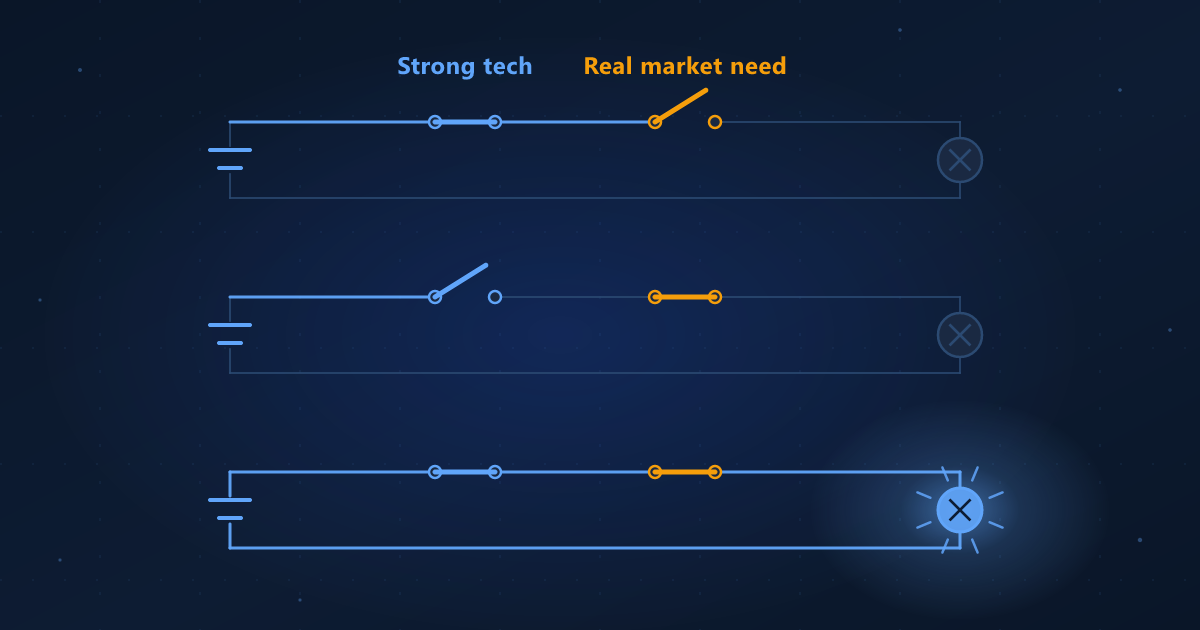
My friend and former Qualcomm colleague Dr. Khaled El-Maleh led Qualcomm's AI/ML and multimedia IP portfolio teams, founded Lucid Techinsights, and now advises on AI innovation, patent portfolios and their monetization. In a recent conversation he gave me a principle I have not stopped thinking about: technical excellence is necessary, but it is not sufficient.
Engineers hear the first half and stop listening. The skill to build something new is real and rare. Khaled's point lives in the second half: without a market that needs the work, and money that lasts until the market finds it, the best engineering in the room still fails.
That matters to anyone who decides where talent hours go. Initiatives fail in two mirror-image ways. Some sell a story with no real technical edge underneath. Others build a real edge that nobody needs enough to pay for. Both are avoidable, and the check that catches them fits in one meeting before the first sprint.
Necessary is not the same as sufficient
A condition is necessary when you cannot succeed without it, and sufficient when it is enough on its own. Oxygen is necessary for a fire, yet it is not sufficient: you also need fuel and a spark. Technical skill works the same way. Without it there is no innovation worth funding. With it alone, there is often nothing anyone buys.
Khaled names what completes the set: a business mindset. That starts with product-market fit, which the investor Marc Andreessen defined as "being in a good market with a product that can satisfy that market."1 It also means funding and cash flow, the money that keeps a team alive while it finds that market.
Put the two halves on two axes and an initiative can sit in one of four places (Figure 1). Only one of them works. The two failure quadrants are mirror images, and each kind of team tends to fall into the one it cannot see from inside.
All story and no substance
The first failure is the loud one: a compelling story with no real technical edge underneath. Theranos is the extreme case. The US Securities and Exchange Commission charged the company and its two leaders with raising more than $700 million from investors through what it called an elaborate, years-long fraud. Its own analyzer could complete only a small number of tests, and the rest ran on modified commercial machines made by others.2
AI has its own version. In 2024 the SEC charged two investment advisers with false and misleading statements about their use of artificial intelligence, and the two paid $400,000 in civil penalties between them. The SEC chair was blunt: "Such AI washing hurts investors."3
Inside a company the pattern is quieter. It is the slide that promises an AI capability before anyone has shown it working on the company's own data. Marketing can open doors. It cannot hold them open once a customer or an auditor tests the claim.
Strong technology and no market
The second failure is the one engineers fall into. Iridium built a satellite phone network that worked, offering calls from almost anywhere on Earth. An analysis from Arizona State University's business school calls it "a technological success, but a market and business failure." After more than $5 billion in investment it had only about 20,000 subscribers, and it went bankrupt within 10 months of beginning operation.4
Startup post-mortems tell the same story at scale. When CB Insights read 111 of them, 35% cited no market need, while only 8% cited a poor product (Figure 2).5 Most of those teams could build. They built something too few people needed.
AI projects inside companies fail the same way. RAND interviewed 65 experienced data scientists and engineers, and the first root cause they reported was that stakeholders misunderstand or miscommunicate what problem the AI is meant to solve.6 By some estimates, RAND notes, more than 80% of AI projects fail, twice the rate of IT projects without AI.6 A strong team pointed at the wrong problem spends talent hours the organization cannot get back.
Cash decides how long you can learn
The last piece of the set is the least glamorous: funding and cash flow. Even a team with a real edge and a real market needs money to last until the two meet. In the 2021 CB Insights analysis, running out of cash or failing to raise was the most cited reason of all, at 38%.5 In its 2026 update, covering 385 venture-backed shutdowns, 70% ran out of capital, and the analysts add that this is "almost always the final cause of death, not the root problem."7
That framing is the useful one for leaders. Cash rarely kills a good initiative on its own. It sets the clock, and a team without market pull spends the clock without learning. Across the US economy the clock is short: of the private-sector establishments that opened in the year to March 2021, 79.1% were still open a year later and only 47.2% after five years.8
Inside a large company the clock is a budget cycle rather than a bank balance, and it runs the same way. A project that cannot show a user who needs it by the next planning round is usually the first one cut, whatever its technical merit.
For the technical reader: runway and a first market check
Runway is cash on hand divided by monthly net spending. An illustrative team of six engineers at a fully loaded $20,000 a month each spends $120,000 a month, so $1.8 million buys 15 months. Fundraising or the next budget review takes the last few, so decide what evidence of market pull you need by month six.
A first market check does not need a market-sizing model. Work bottom-up: the number of customers who have the problem, times what each would pay in a year. If the result cannot cover the team's cost, or you cannot name ten of those customers, the edge is still a science project. The count that matters is named customers who agreed to try it, a smaller and more honest number than the total market on the slide.
What leaders should do
- Ask for evidence of the technical edge on your own data or problem, shown by the team, before funding the story around it. A demo on someone else's data does not count.
- Ask the team to name ten people or teams who have the problem and have agreed to try the solution, and to name who owns the business side of the initiative.
- Set the clock in writing: how many months of funding the initiative has, and what evidence of market pull it must show by the halfway point to continue.
- Pair every strong technical lead with someone who owns product-market fit and budget from the first week, instead of adding that person after the first prototype.